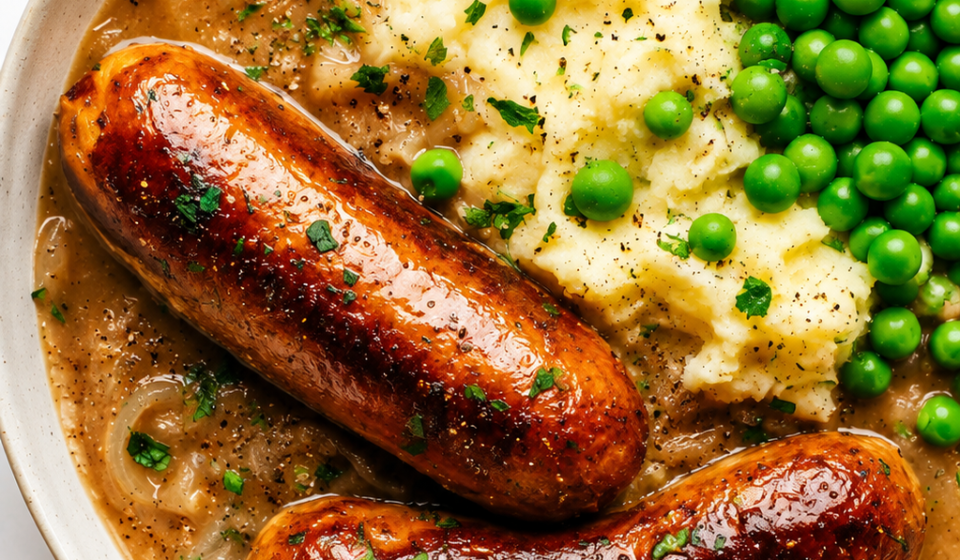

Sausage and mash is exactly what it sounds like: sausages served on a bed of mashed potato, usually finished with onion gravy. It is one of the simplest dishes in British cooking, and also one of the most enduring, regularly cited as the nation’s favourite comfort food. This guide covers where the dish comes from, what makes a good version of it, which sausages and potatoes work best, and how to cook it safely.
Sausage and mash is also known by its more colloquial name, bangers and mash. In a 2009 survey commissioned by the TV channel Good Food, it was named Britain’s most popular comfort food, ahead of dishes such as fish and chips and roast dinners.
Where the name “bangers” comes from
The two halves of the dish have very different histories. Romans introduced sausages to Britain as early as the 4th century, and sausage-making continued in various forms for centuries afterwards. Potatoes are far more recent arrivals, reaching Britain from South America by way of Spanish exploration in the 16th century, and mashed potato recipes began appearing in British cookbooks by the mid-18th century, including Hannah Glasse’s The Art of Cookery, published in 1747. Rimping
The word “banger,” meanwhile, is a 20th-century addition. It’s often assumed to date from the Second World War, but the Oxford English Dictionary records it in use at least as far back as 1919, putting its origin closer to the First World War. During that period, meat shortages meant sausages were often padded out with water and cheaper fillers. The high water content made them prone to bursting or popping loudly when fried hence “bangers.” According to Britannica, this explanation, while widely repeated, is described as the “supposed” origin, since it rests on oral history rather than a single documented source.
Why the dish became a national staple
Sausage and mash owes its lasting popularity to the same qualities that made it useful a century ago: it’s cheap, quick, filling, and needs only a handful of ingredients. Wikipedia’s entry on the dish notes that even when cooked at home, it’s often thought of as an example of pub grub food that is relatively quick and easy to prepare in large quantities, which is part of why it remains a fixture on pub menus across the UK.
Choosing the right sausages
There’s no single “correct” sausage for the dish, but some regional British varieties are especially associated with it. Cumberland sausages, from Cumbria in northwest England, are typically coarse-textured, herb-seasoned and sold coiled rather than in links. Lincolnshire sausages, from eastern England, are usually seasoned with sage, thyme and sometimes nutmeg. Both are widely available in UK supermarkets and butchers, and either works well with mash. In the US, where “bangers” isn’t a household term, any good-quality fresh pork or beef breakfast or dinner sausage is a reasonable substitute, though the texture and seasoning will differ from a traditional British banger.
Picking potatoes that mash well
Not all potatoes behave the same way once boiled and mashed. Floury (high-starch) varieties break down into a light, fluffy texture, while waxy varieties tend to turn gluey or dense.
In the UK, Maris Piper is the most commonly recommended variety for mash. It’s the most widely grown potato variety in the UK, accounting for around 16% of the planted area as of 2014, and was originally bred in the 1960s at the Plant Breeding Institute in Cambridge for resistance to potato cyst nematode, a common pest. Great British Chefs notes that floury varieties such as Maris Piper or King Edward are generally considered best for mashing, though some specialists favour the smoother Desiree for a more velvety result. In the US, Yukon Gold and Russet potatoes serve a similar purpose and are the more commonly available equivalents. Maris Piper +2
A few practical points make a real difference to texture:
- Cut potatoes into even-sized chunks so they cook at the same rate.
- Avoid overcooking, since waterlogged potatoes make a grainy, wet mash rather than a smooth one.
- Add warm (not cold) milk or cream and butter, so the mash doesn’t cool and stiffen as you mix it in.
- A potato ricer or fine sieve gives a smoother finish than mashing by hand with a fork, particularly for floury varieties.
Putting it together: method and gravy
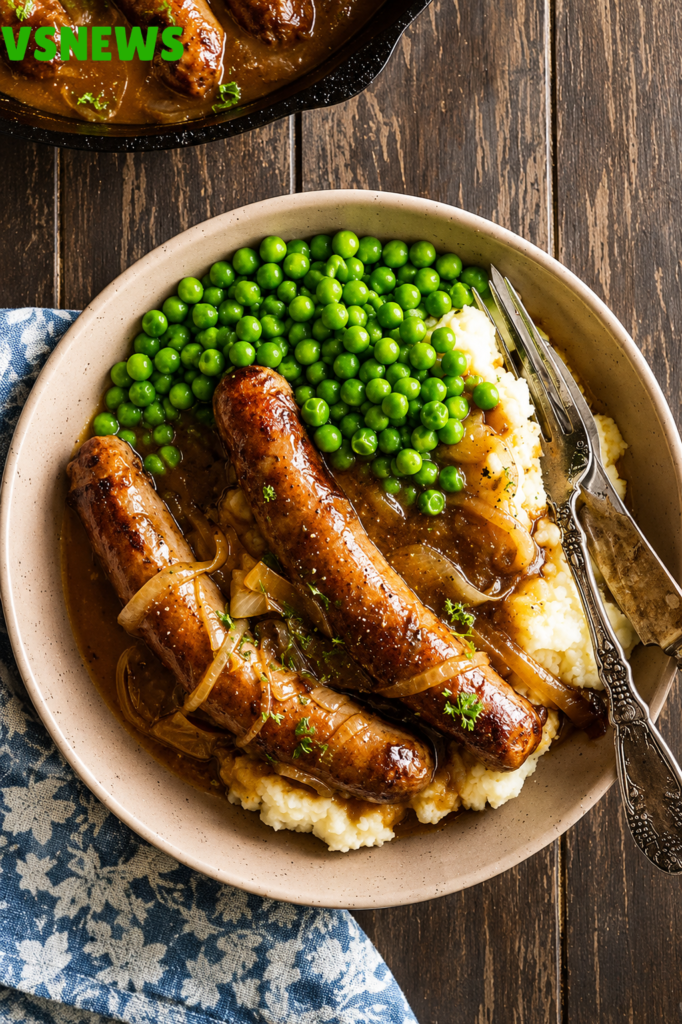
There’s no fixed recipe, but the basic method is consistent across most versions: sausages are pan-fried, grilled or oven-baked until cooked through, while potatoes are boiled and mashed separately with butter and milk. Onion gravy made by slowly cooking sliced onions until caramelised, then adding flour and stock is the traditional accompaniment, and Wikipedia’s entry lists it alongside fried onions and peas as the dish’s usual and optional additions.
Cooking times vary by sausage thickness and method, but pan-frying over medium heat for roughly 10–15 minutes, turning regularly, is typical for standard-sized links. Oven-baking at around 190–200°C (375–400°F) for 20–25 minutes is a lower-maintenance alternative that reduces the risk of burning the outside before the inside is cooked.
Cooking sausages safely
Because sausages are made from ground or minced meat, safe cooking is about reaching a specific internal temperature rather than judging by colour. Grinding distributes any surface bacteria throughout the meat, so the centre needs to get hot enough to kill it unlike a whole cut of meat, where only the surface needs thorough cooking.
In the US, the USDA’s Food Safety and Inspection Service states that uncooked sausages containing ground beef, pork, lamb or veal should be cooked to 160°F, while those containing ground turkey or chicken should reach 165°F. The agency also stresses more broadly that colour and the appearance of juices are not reliable indicators of safety a food thermometer is the only accurate way to check. USDA FSISUSDA FSIS
In the UK, the Food Standards Agency’s official safe-cooking guidance advises that sausages should be cooked thoroughly until steaming hot all the way through, with no pink or red in the centre, and recommends using a clean, disinfected temperature probe to confirm this where possible. Numerous UK food-safety guides cite a target core temperature of 75°C, though this exact figure does not appear on the FSA’s own published safe-cooking sheet referenced above, so it should be treated as general good practice rather than an official FSA figure. When in doubt, cook until there is no pink remaining and juices run clear, and use a thermometer if you have one. food
A note on nutrition
Sausage and mash is a hearty, energy-dense meal, and its nutritional profile depends heavily on the specific sausages used (fat content and salt vary considerably between brands) and how the mash is prepared (the amount of butter, cream or cheese added). There is no single verified figure for “the” nutritional content of the dish, since recipes differ too widely anyone monitoring fat, salt or calorie intake should check the specific product labels for their sausages and calculate the mash separately based on the ingredients used.
FAQs
Is bangers and mash the same as sausage and mash?
Yes. Wikipedia’s entry on the dish lists “sausages and mash” as an alternative name for bangers and mash; both terms refer to the same combination of sausages and mashed potato.
Do I need onion gravy to make it “authentic”?
No single recipe is definitive, but onion gravy is the most traditional accompaniment. Peas and fried onions are also common but optional additions rather than essential components.
Can I make sausage and mash with chicken or vegetarian sausages?
Yes. The core structure of the dish sausage plus mash works with any sausage type. If using poultry sausages, follow poultry-specific cooking temperatures (165°F/74°C in the US) rather than pork or beef guidance, since poultry requires a higher safe temperature.
you may also read about: Best Toddler Car Seats: What Actually Matters When Choosing One