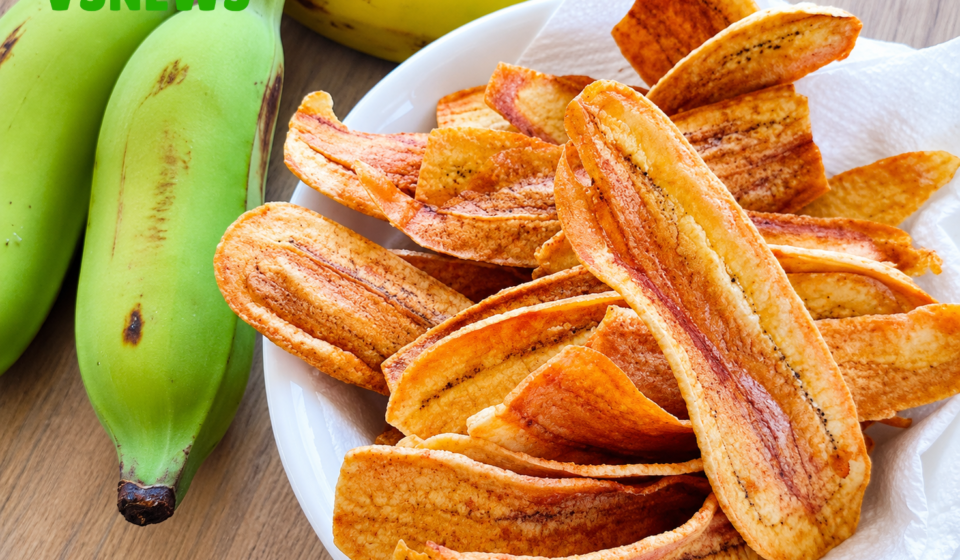

How to make banana chips comes down to a simple routine. Slice firm, yellow bananas about ¼ inch (6 mm) thick, dip the slices briefly in lemon juice and water, and dry them at 135 to 140°F (57 to 60°C) until pliable to crisp. In a dehydrator that typically takes 6 to 10 hours. Cool the chips fully, then store them airtight. For a crunchier, shop-style chip, you can fry slices of under-ripe green banana in hot oil instead.
One expectation to set early: home-dried chips are usually chewier than packaged ones. The US National Center for Home Food Preservation notes that some commercial banana chips get a treatment to make them crisp, and that this can’t be done at home, as quoted by Healthy Canning.
Choosing and slicing the bananas
Sources disagree here, and it’s worth knowing why. The drying guides summarised by Healthy Canning, including Ball, Excalibur and the University of Georgia’s So Easy to Preserve, recommend solid yellow or lightly brown-flecked bananas and say to avoid bruised or overripe fruit. Excalibur says all-yellow or lightly speckled fruit will be the sweetest and advises avoiding green ones.
Practical Action, a UK charity that publishes small-scale food processing guides, takes the opposite view. Its banana chips brief says under-ripe green bananas give the right texture for chips and that ripe fruit is too soft. That brief is a 2008 document written for small processors, mostly for frying.
For a home batch in a dehydrator or oven, the yellow-but-firm approach has the stronger backing and gives a sweeter result. Green bananas make more sense if you plan to fry.
Slice thickness varies by source: ⅛ to ¼ inch (Excalibur), ¼ to ½ inch (Ball), and 5 to 8 mm (Practical Action). Around ¼ inch is a sensible middle. Penn State Extension adds that pieces of the same size, shape and thickness dry evenly, so a mandoline or a steady hand helps.
How to make banana chips in a dehydrator or oven
1. Stop the browning. Peeled bananas darken quickly. Penn State suggests equal parts bottled lemon juice and water as a pretreatment, and also lists ascorbic acid (vitamin C) or citric acid solutions. Ratios differ between sources, so follow one source’s recipe rather than mixing them. Keep the soak short. Practical Action recommends 3 to 5 minutes and warns that longer soaking leaves slices too wet and slow to dry. Drain well.
2. Set the temperature. The banana-drying sources compared by Healthy Canning range from 130 to 140°F (54 to 60°C). Penn State’s general fruit advice is to start at 145°F (62°C) for the first hour when there is surface moisture, then drop to 135 to 140°F. Drying too hot can cause case hardening, where the outside sets hard and traps moisture in the middle of the slice.
3. Arrange and dry. Lay slices in a single layer so they don’t touch or overlap. Expect 6 to 10 hours depending on your humidity and slice thickness. Practical Action’s dried-chip flow chart suggests about 8 hours at 60°C.
4. Check for doneness. Penn State says fruit is dry when it’s pliable and no beads of moisture appear when you press a slice between your fingers. Ball describes bananas as ready when “pliable to almost crisp.” Don’t expect a glass-like snap from every slice.
5. Cool and condition. Let the chips come to room temperature before packing. Then do what Penn State calls conditioning: pack them loosely in an airtight container for several days. If condensation forms inside, they need more drying.
Using an oven instead
An oven works, but only if it can hold a low temperature. Michigan State University Extension warns that if your oven can’t reach 140°F, the food may cook rather than dry. Both MSU and Penn State advise propping the door open (Penn State says 2 to 3 inches) so moisture escapes, and a fan outside the door helps. Many ovens, especially in the UK, don’t go this low, so check with an oven thermometer.
The University of Kentucky’s extension service notes that oven drying is slower and less efficient than a dehydrator, and cautions that it isn’t a safe practice in a home with small children.
Getting crispier banana chips
Two things help, within limits. First, thin slices dry crisper. Penn State notes that some thinly sliced fruits, such as apple chips, will dry crisp, though it doesn’t say this about bananas specifically. Second, a honey or syrup dip. Excalibur recommends a honey dip for crisper slices, and Practical Action gives a recipe: mix 1 cup of sugar into 3 cups of boiling water, stir in 1 cup of honey, and soak the slices for 3 to 5 minutes before draining. Dipped chips are sweeter and higher in calories, and Practical Action notes that many commercial chips are made this way.
Penn State warns that syrup-treated fruit is stickier, so expect that trade-off.
Fried banana chips
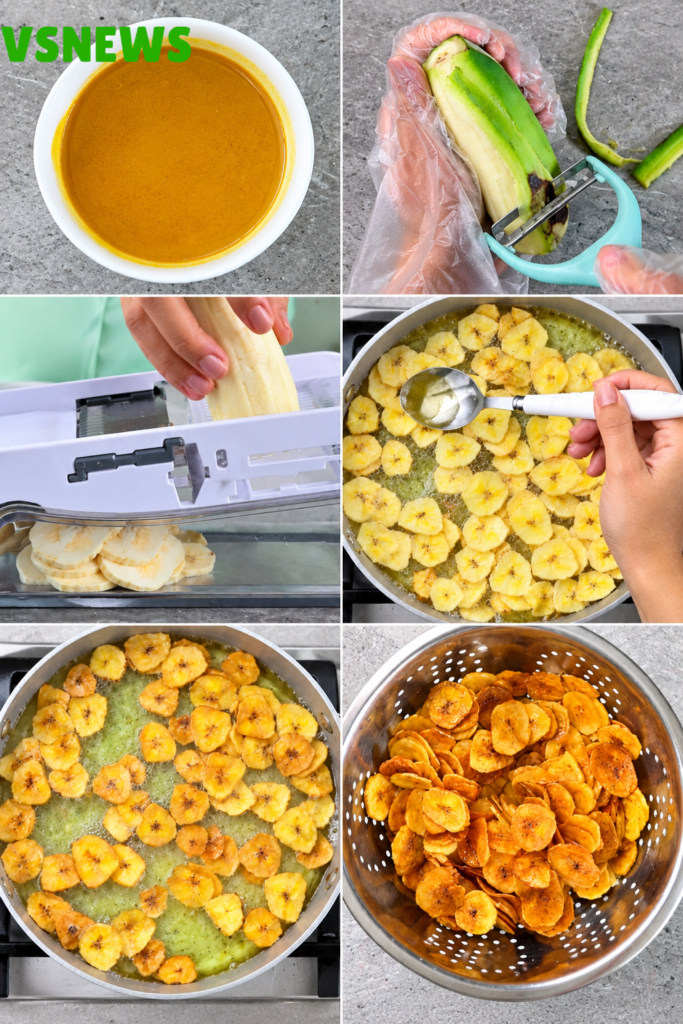
Frying gives the crunchy, savoury chip you may know from shops, and it’s the method Practical Action describes for green bananas. Its steps are:
- Slice under-ripe bananas 5 to 8 mm thick and give them an anti-browning dip.
- Optionally pre-dry the slices for 5 to 6 hours at 60°C until rubbery, which the brief says makes the chips crispier.
- Heat clean vegetable oil to 180 to 200°C, checking with a thermometer. Too cool and the chips soak up oil, too hot and they burn.
- Fry one layer at a time and lift the chips out when they float and turn golden brown. They cook quickly.
- Drain, and add salt, pepper or chilli powder while they’re still slightly oily.
Practical Action describes fried chips as a savoury, high-calorie snack with a shelf life of about two months in airtight packaging, because the oil can turn rancid. That oil temperature is high, so keep children away and never leave the pan unattended. Plantain chips follow a similar method but are cut much thinner, about 2 mm, and fried at a lower temperature of around 150°C in the brief’s version.
Storing homemade banana chips
Storage matters as much as the method when you’re learning how to make banana chips. Cool the chips completely before packing, store them away from heat and direct light, and watch the container for the first few days. Healthy Canning’s guidance is to dry them a bit more if you see condensation. Penn State adds that dried fruit lasts longer in the fridge or freezer.
Shelf-life claims are inconsistent. Practical Action’s text says dried chips can last up to six months if dried to low moisture, yet its own flow chart says two months. There’s no reliable public figure for home-dried banana chips specifically, so go by sight and smell, and throw out anything that looks or smells off.
you may also read about: Pizza Dough Recipe: A Simple Method for Home Bakers