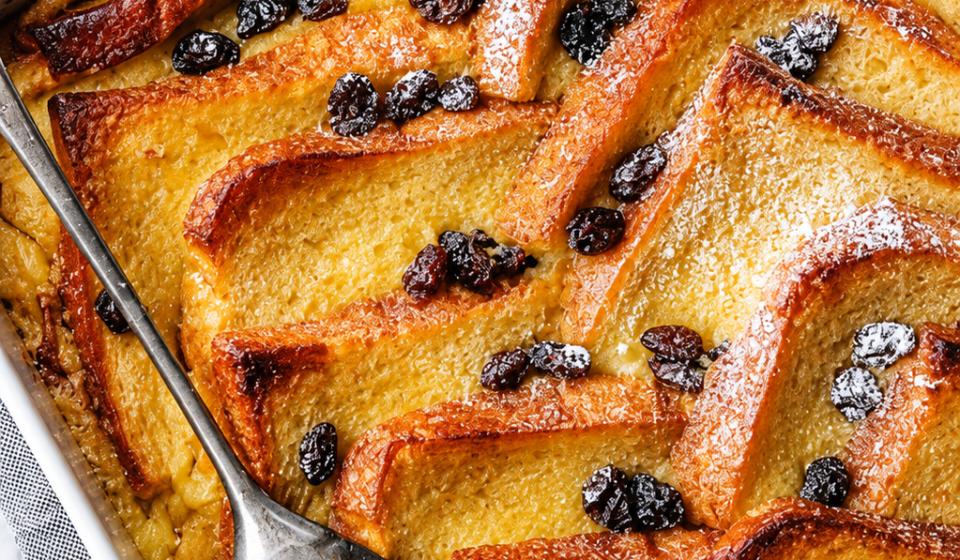

Bread and butter pudding is a British baked dessert made by layering buttered bread, usually with raisins or sultanas, and covering it in an egg custard before baking until the top turns golden and slightly crisp while the inside stays soft and creamy. It’s one of the best known “nursery puddings” in British cooking, and its enduring appeal comes down to two things: it costs very little to make, and it turns stale bread into something worth serving for dessert.
The dish shouldn’t be confused with plain bread pudding, a denser, cake like bake made from torn or soaked bread mixed directly into the batter rather than layered in slices. Bread and butter pudding, by contrast, keeps the bread in distinct buttered layers, which is what gives it that contrast between a crisp top and a custardy middle.
Where the recipe comes from
The origins of bread based puddings in England are thought to stretch back centuries, to a time when cooks needed a way to use up stale bread rather than throw it away. According to Wikipedia’s summary of the dish’s history, one of the earliest recipes actually published under the name “bread and butter pudding” appears in Eliza Smith’s cookbook The Compleat Housewife, printed in 1728. The dish was later included in Hannah Glasse’s influential The Art of Cookery Made Plain and Easy (1747), which set out the now familiar method of layering thin, buttered bread slices in a dish, soaking them in egg custard and adding dried fruit and spices.
By the Victorian era, the cookery writer Eliza Acton had refined the recipe further. Her 1845 version called for milk flavoured with lemon rind and either bitter almonds or cinnamon, enriched with cream and sugar and thickened with beaten egg and, notably, finished with a glass of brandy stirred into the custard, a detail confirmed on the Wikipedia entry for the dish. That period also cemented bread and butter pudding’s reputation as a staple of British nursery food: plain, filling, and cheap enough to feed a household of children on a limited budget.
The pudding has stayed popular through leaner times too. It’s frequently mentioned as a comfort food that used minimal ingredients bread, milk, eggs and a little sugar making it well suited to rationing era cooking, though it’s worth noting that detailed official wartime attribution beyond general historical accounts is harder to pin down with certainty.
How it differs from other bread puddings
It helps to know where bread and butter pudding sits among its relatives, since the names get used loosely:
- Bread pudding uses bread that’s been torn or soaked and mixed into a batter, giving a denser, more uniform texture, closer to a cake.
- Bread and butter pudding keeps the bread in buttered slices or triangles, layered with dried fruit, so it bakes into distinct strata with a crisp top.
- Om Ali, an Egyptian dessert, uses a similar principle of bread or pastry baked in milk, but typically includes nuts such as pistachios and leaves out the egg, according to Wikipedia.
Chefs at Great British Chefs describe bread and butter pudding as a dish that “shouldn’t be rushed, or tampered with too much,” pointing to the classic combination of creamy custard and slightly crisp bread as the reason it has lasted so long in British kitchens, from home cooking through to restaurant menus.
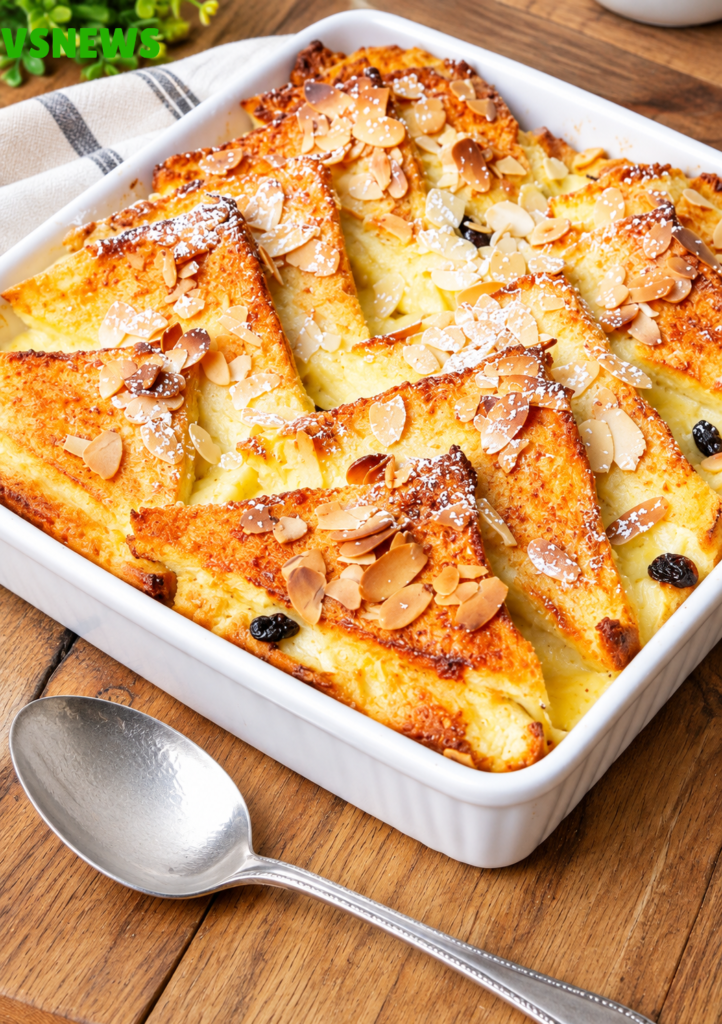
What a traditional recipe involves
Most authoritative versions of the recipe follow a broadly similar method, even if quantities and flavourings vary between cooks:
- Bread traditionally white bread that is a day or two old, since drier bread absorbs custard better than fresh, moist bread is buttered on both sides and layered in a greased ovenproof dish, often with the crusts removed.
- Dried fruit, most commonly sultanas or raisins, is scattered between the layers.
- A custard is made by warming milk (sometimes with added cream) and whisking it into beaten eggs and sugar, often flavoured with vanilla, nutmeg, cinnamon or lemon zest.
- The custard is poured over the bread and left to soak, typically for at least 30 minutes, so the bread absorbs the liquid rather than sitting in a pool of it.
- The dish is baked, usually somewhere between 160°C and 180°C, until the custard has set but still has a slight wobble, and the top is browned.
A modern recipe published by SAVEUR follows this same basic structure, adapted from a British “no frills” family cookbook, using a simple custard of eggs, sugar, milk and a pinch of salt poured over buttered, raisin studded bread and baked for roughly an hour. It’s a useful illustration of how consistent the core method has stayed, even as ingredients and presentation have moved upmarket in some restaurant versions, which now use brioche, panettone or croissant in place of plain sliced bread.
Serving and variations
Bread and butter pudding is most often served warm, either on its own or with extra custard, cream, or a scoop of ice cream. Some versions dust the top with icing sugar or add a layer of jam, marmalade or golden syrup before baking. Restaurant chefs have also experimented with more elaborate accompaniments: Great British Chefs’ collection includes a version served with clotted cream and another paired with chocolate sorbet, showing how flexible the base recipe is once the fundamentals of bread, butter, egg and milk are in place.
There are also savoury takes on the format, layering buttered bread with cheese and vegetables instead of fruit and sugar, which Great British Chefs notes is often promoted as a way to reduce household food waste, given how much bread and milk are thrown away in the UK each year.
A few practical notes
Because the dish relies on eggs and dairy, it should be baked until the custard has properly set, both for texture and food safety reasons, and any leftovers should be refrigerated rather than left at room temperature. Recipes vary in their exact oven temperatures and timings, so it’s worth following a specific recipe’s instructions rather than assuming one method suits every combination of bread and dish size. As with most simple, ingredient driven bakes, results depend heavily on the type and age of bread used very fresh bread tends to turn soggy, while bread that’s too stale can end up dry in places even after soaking.
you may also read about: Katie Price News: Why She’s Divorcing Lee Andrews and What She Revealed About Her Latest Surgery